
Hot Melt Water-Based Adhesive: Which Is Better for Your Manufacturing?
Choosing between hot melt water-based adhesive technologies is one of the most critical decisions manufacturers face. The wrong choice can slow production, increase costs, and compromise product quality. The right choice boosts efficiency, reduces waste, and delivers durable bonds that meet customer expectations.
At Kelan Adhesive, we manufacture both hot melt and water-based formulations for clients across packaging, furniture, textiles, and automotive industries. This guide compares both technologies side-by-side to help you make an informed decision.
What Is Hot Melt Adhesive?
Hot melt adhesive is a thermoplastic polymer that becomes liquid when heated and solidifies when cooled. It contains no solvents or water, making it 100% solid. Manufacturers apply it using heated glue guns, spray systems, or roller coaters at temperatures between 120°C and 180°C.
Key characteristics of hot melt adhesive:
- Fast curing: Bonds form within seconds of application
- No drying time: Immediate handling and packaging
- 100% solid content: No shrinkage or volume loss
- Wide temperature range: EVA, PUR, and polyamide options available
- Easy storage: Stable at room temperature for 12-24 months
Common types include EVA hot melt adhesive for general packaging, PUR hot melt adhesive for demanding applications, and polyamide hot melt adhesive for high-temperature resistance.
What Is Water-Based Adhesive?
Water-based adhesive uses water as the primary carrier for polymer resins such as acrylic, polyurethane, or natural rubber. The adhesive applies as a liquid and cures as water evaporates or absorbs into the substrate. Application methods include brushing, spraying, rolling, or dipping.
Key characteristics of water-based adhesive:
- Low VOC emissions: Environmentally friendly, safe for indoor use
- Long open time: Allows repositioning before curing
- Thin application: Creates lightweight, flexible bonds
- Room temperature curing: No heating equipment required
- Washable formulations: Available for textile applications
Popular variants include water-based spray adhesive for upholstery, water-based acrylic adhesive for labels, and water-based PU adhesive for shoe manufacturing.
Hot Melt vs Water-Based Adhesive: Side-by-Side Comparison
| Feature | Hot Melt Adhesive | Water-Based Adhesive |
|---|---|---|
| Curing Speed | Seconds to minutes | Minutes to hours |
| Application Temperature | 120°C – 180°C | Room temperature |
| VOC Emissions | Very low | Extremely low |
| Initial Bond Strength | High immediate tack | Lower initial tack, builds over time |
| Final Bond Strength | Strong, durable | Very strong, flexible |
| Heat Resistance | Good to excellent (PUR/polyamide) | Moderate |
| Water Resistance | Moderate to excellent (PUR) | Variable, special grades available |
| Substrate Compatibility | Paper, plastic, wood, foam, fabric | Paper, fabric, leather, wood, some plastics |
| Equipment Required | Heated applicators, glue guns | Spray guns, brushes, rollers |
| Storage Requirements | Cool, dry place | Above freezing, sealed containers |
| Shell Life | 12 – 24 months | 6 – 12 months |
| Cost per Application | Lower (100% solids, no waste) | Moderate (water evaporates) |
Performance Comparison by Industry
Packaging Industry
Winner: Hot Melt Adhesive
Carton sealing, case forming, and tray erection demand speed. Hot melt adhesive sets within seconds, allowing immediate stacking and shipping. Water-based adhesives require drying time, slowing production lines and risking bond failure if handled too early.
Best choice: EVA hot melt adhesive for standard packaging; low-temperature grades for cold storage applications.
Furniture and Upholstery Manufacturing
Winner: Depends on Application
For foam-to-fabric bonding in sofas and mattresses, water-based spray adhesive offers superior flexibility and breathability. The thin adhesive layer preserves softness and comfort. However, for edge banding and veneer lamination on furniture frames, hot melt adhesive provides faster processing and stronger initial bonds.
Best choice: Water-based for upholstery; PUR hot melt for structural furniture assembly.
Textile and Apparel
Winner: Water-Based Adhesive (with exceptions)
Seamless garment construction and fabric lamination favor water-based adhesives because they remain soft, stretchy, and breathable after curing. However, for bonding fabric to rigid substrates or creating waterproof seams, PUR hot melt adhesive outperforms due to its superior wash resistance and durability.
Best choice: Water-based for soft garments; PUR hot melt for technical textiles and outdoor gear.
Automotive Manufacturing
Winner: Hot Melt Adhesive
Headliners, seat covers, and interior trim face extreme temperatures and vibration. Hot melt adhesives, especially PUR and polyamide formulations, withstand heat up to 120°C and maintain bond integrity under stress. Water-based adhesives struggle with automotive heat cycles and humidity.
Best choice: PUR hot melt for interior trim; polyamide for under-hood applications.
Woodworking and Construction
Winner: Hot Melt Adhesive
Edge banding, profile wrapping, and panel lamination require fast-setting bonds that hold immediately. Hot melt adhesive delivers this speed. Water-based adhesives need clamping and drying time, extending production cycles.
Best choice: EVA hot melt for general woodworking; PUR hot melt for moisture-resistant exterior applications.
Label and Sticker Manufacturing
Winner: Hot Melt Adhesive
High-speed label applicators demand instant bonds. Hot melt adhesive blocks and sticks feed directly into equipment, setting immediately upon contact. Water-based adhesives require drying tunnels, increasing equipment footprint and energy costs.
Best choice: EVA hot melt blocks for paper labels; removable-grade hot melt for repositionable stickers.
Environmental and Safety Considerations
VOC Emissions
Both technologies outperform solvent-based adhesives. Water-based adhesives release the lowest VOC levels because they contain no organic solvents. Hot melt adhesives also produce minimal VOCs since they are 100% solid and release no solvents during curing.
For strict indoor air quality requirements: Water-based adhesive has a slight edge.
Energy Consumption
Hot melt adhesives require heated applicators, consuming electricity during operation. However, the curing process itself releases no energy. Water-based adhesives need less application energy but often require drying ovens or extended drying areas, which can offset savings.
For energy-conscious facilities: Calculate total system energy, not just application energy.
Waste and Recycling
Hot melt adhesives generate no liquid waste. Excess adhesive cools into solid scrap that can often be recycled or disposed of as general waste. Water-based adhesives require cleanup with water, creating wastewater that may need treatment before disposal.
Cost Analysis: Total Cost of Ownership
| Cost Factor | Hot Melt Adhesive | Water-Based Adhesive |
|---|---|---|
| Adhesive price per kg | Moderate to high | Low to moderate |
| Application equipment | Heated tanks, glue guns | Spray systems, pumps |
| Energy costs | Heating during operation | Drying ovens or extended space |
| Production speed | Fast, immediate handling | Slower, requires drying |
| Rework rate | Low | Moderate (bonds can shift before curing) |
| Waste disposal | Solid scrap, easy | Liquid wastewater, may need treatment |
| Total cost per 1,000 units | Often lower | Higher due to slower speed |
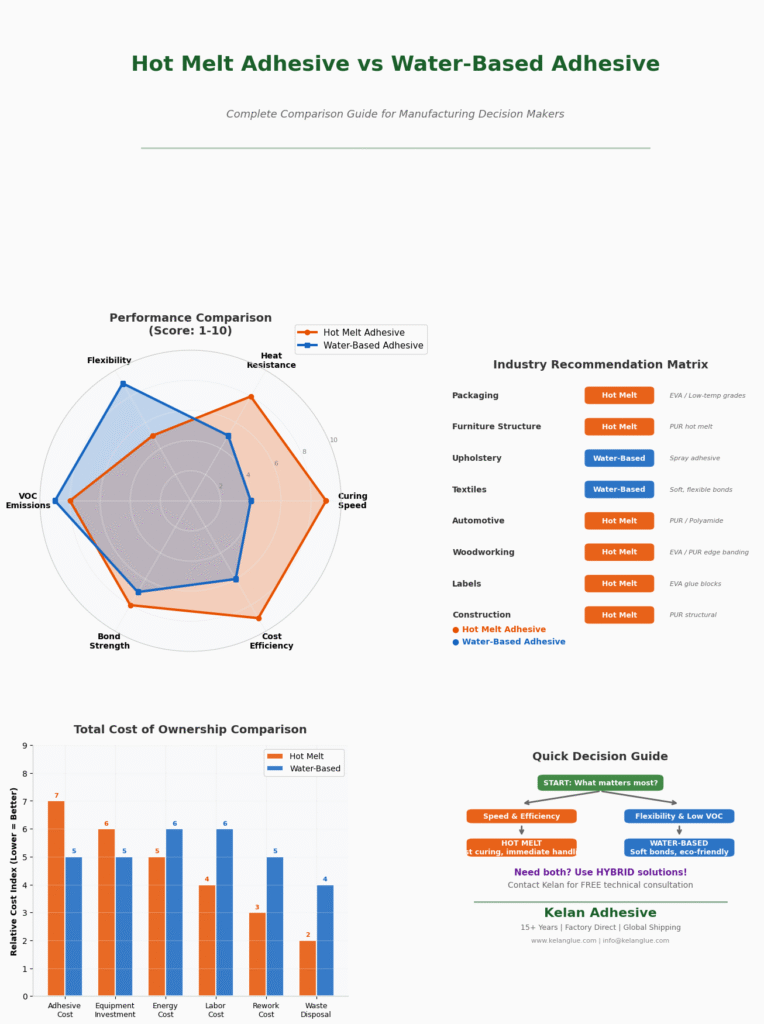
Key insight: While water-based adhesives may cost less per kilogram, the total cost of ownership often favors hot melt due to faster production speeds and lower rework rates.
When to Choose Hot Melt Adhesive
Select hot melt adhesive when your application requires:
- High-speed production with immediate handling
- Strong initial tack for assembly line efficiency
- Heat resistance above 80°C
- Water resistance for outdoor or wash applications (choose PUR)
- Minimal equipment footprint
- Long shelf life and easy storage
Recommended products: EVA glue sticks for general use, PUR adhesives for demanding applications, K-3701 glue blocks for labels.
When to Choose Water-Based Adhesive
Select water-based adhesive when your application requires:
- Maximum flexibility and softness in the final bond
- Extremely low VOC emissions for indoor air quality
- Breathable bonds for textiles and upholstery
- Room temperature application without heating equipment
- Repositioning time before final curing
- Washable or dry-cleanable bonds (special formulations)
Recommended products: Water-based spray adhesive for upholstery, water-based acrylic for labels.
Hybrid Solutions: Combining Both Technologies
Many manufacturers use both hot melt and water-based adhesives in different production stages. For example:
- Furniture factories: Hot melt for frame assembly + water-based for upholstery
- Automotive plants: PUR hot melt for interior trim + water-based for sound dampening pads
- Packaging facilities: Hot melt for carton sealing + water-based for printed label overlays
This hybrid approach optimizes cost, speed, and performance across the entire manufacturing process.
Frequently Asked Questions
Can I switch from water-based to hot melt adhesive?
Yes, but evaluate equipment compatibility first. Hot melt requires heated applicators, which differ from water-based spray or roller systems. Contact Kelan for application consulting and equipment recommendations.
Is hot melt adhesive stronger than water-based?
Hot melt provides stronger initial tack. Water-based often achieves stronger final bond strength after full curing. For immediate handling, hot melt wins. For maximum long-term strength on flexible substrates, water-based may perform better.
Which adhesive is more environmentally friendly?
Both are eco-friendly compared to solvent-based options. Water-based releases slightly lower VOCs. Hot melt generates no wastewater. The “greener” choice depends on your specific environmental priorities.
Can hot melt adhesive be used on fabric?
Yes, with the right formulation. PUR hot melt adhesive and hot melt adhesive film work excellently on fabrics. Standard EVA hot melt may be too rigid for soft textiles.
How do I test which adhesive works best?
Request samples from Kelan and conduct peel tests, shear tests, and environmental aging tests on your actual substrates and under your operating conditions. We provide free technical support for sample evaluation.
Conclusion
Neither hot melt adhesive nor water-based adhesive is universally superior. The best choice depends on your substrate, production speed, environmental requirements, and cost structure.
Quick reference:
- Choose hot melt for speed, heat resistance, and packaging/furniture/woodworking
- Choose water-based for flexibility, low VOC, and textile/upholstery applications
- Consider hybrid solutions for complex manufacturing environments
Still unsure? Contact Kelan Adhesive for a free technical consultation. Our engineers will analyze your application and recommend the optimal formulation from our complete range of hot melt and water-based adhesives.
Learn more about adhesive technology on Wikipedia.